Open-source PaaS for developers

Deploy to your own servers
without the ops work.

Connect a repository, pick a server — yours or ours — and ship with HTTPS and zero-downtime deploys.

No server yet? Upload a static site and get a https://…pushify.dev address.

Key features

A hosted platform’s workflow.Servers you own.

Pushify runs the builds, the proxy, the certificates and the rollbacks. You keep the servers, the data and the bill.

Push to deploy

Every push builds a fresh image. Traffic moves only after the new container passes its health check.

Your server or ours

Connect any VPS over SSH, or run on a managed server. Same dashboard, same deploys.

Databases, backed up

PostgreSQL, MySQL, MongoDB and Redis in a few clicks, with scheduled backups you can keep off the server.

Open source

MIT licensed, API to dashboard. Read the code, self-host the whole platform, leave whenever you like.

The dashboard

Every app, server and database in one place.

Deploys, logs, metrics, backups and domains — for the whole team.
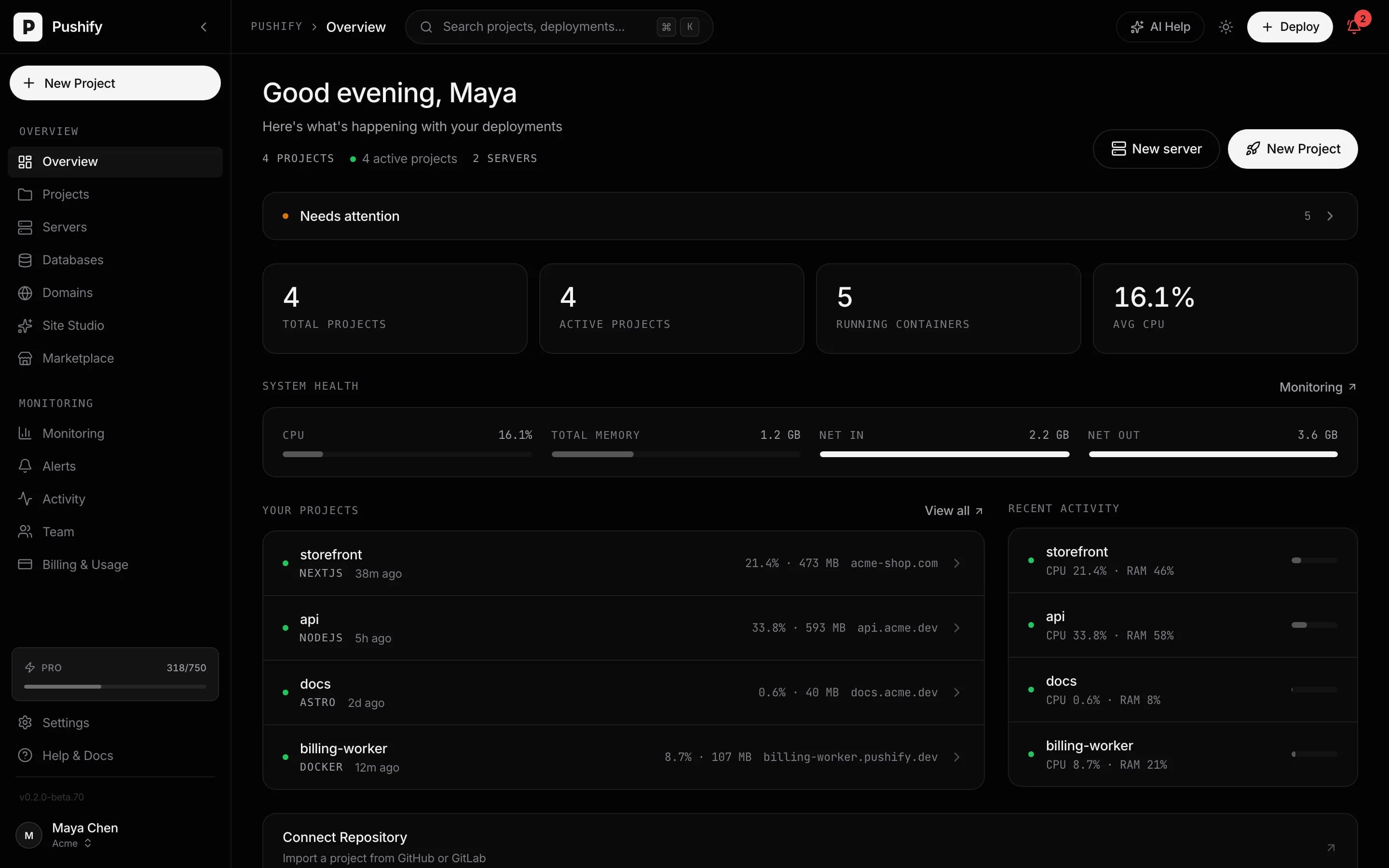
Pushify dashboard overview with projects, stats and recent activity
The real dashboard, with sample data.

In production

From git push to live — and after.

Deploys, previews, rollbacks, scaling, backups and alerts: the work Pushify does for you, line by line.

Transparent pricing

Your bill, side by side.

A rough monthly estimate from published list prices. Move the sliders to match your setup.

3
2
$5
0.5
0.5
Vercel
~$40/mo

2 × $20 Pro seats. Bandwidth beyond 1 TB and function usage billed extra.

Railway
~$45/mo

$20 Pro (incl. $20 usage) + 3 × (0.5 vCPU × $20 + 0.5 GB × $10). Egress extra.

Pushify
~$20/mo

Hobby plan + $5 to your server provider. No per-seat fee within the plan’s member limit, no per-GB metering.

Sources: Vercel · Railway — List prices checked 2026-09-10. Usage-based bills vary; this is an estimate, not a quote.

The difference

Hosted platform vs. Pushify

What changes when the servers are yours.

Hosted platform

  • Seat fees on some platforms (Vercel: $20 per deploying seat)
  • Bandwidth and usage billed on top
  • Your app runs on their infrastructure
  • Closed source — you can’t run it yourself

Pushify

  • Flat plan, no per-seat fee within its member limit
  • No per-GB metering
  • Runs on your own server, or a managed one
  • Open source — self-host it if you want

FAQ

Things you might ask.

What exactly is Pushify?
Pushify is an open-source PaaS (Platform-as-a-Service) for developers who want Vercel-like simplicity without the vendor lock-in. You connect a GitHub repo, choose a server, and Pushify handles building, deploying, scaling, SSL, and monitoring. Either use our managed cloud or self-host the entire platform on your own infrastructure.
How is it different from Vercel or Render?
Vercel and Render are closed-source SaaS — your apps run on their infrastructure, and you pay their plan fees plus metered usage such as bandwidth. Pushify is open-source: you can self-host the whole platform, run apps on your own VPS, and avoid lock-in. Plans start at $0 and scale predictably.
How is it different from Coolify or CapRover?
Coolify is an excellent open-source self-hosted platform with team support and its own paid Coolify Cloud; CapRover is free and Apache-2.0 licensed with no paid tier. Pushify differs in a few ways: its hosted control plane has a free plan, it can rent Hetzner servers from the dashboard without a Hetzner account (billed hourly from a prepaid wallet), and it includes a 24-app marketplace, an AI assistant and a no-code site builder.
Is the source code really open?
Yes. Pushify's frontend, backend, and CLI are MIT-licensed and public on GitHub. You can fork, audit, contribute, or run a private instance with no restrictions.
Can I bring my own servers?
Absolutely. Add any Linux VPS via SSH (DigitalOcean, AWS, Hetzner, your home server) and Pushify will install Docker and Nginx, then deploy your apps there. You can also provision Hetzner Cloud servers from the dashboard with one click.
What payment methods do you accept?
Platform subscriptions and infrastructure credit top-ups use major credit and debit cards via Stripe. Payments are encrypted; we never store your full card number on our servers.
How are managed Hetzner servers billed?
They use a prepaid infrastructure credits wallet (USD), separate from your platform subscription. Credits decrease hourly while the server is running. Top up in Dashboard → Billing before creating a server, and keep roughly one month of estimated cost available. If credits run out, the server stops until you add more. BYOS servers you connect with SSH are not charged through this wallet.
What happens if my platform subscription payment fails?
Stripe retries the charge. Your organization is marked past due: you cannot create new projects, servers, databases, or deployments until you update your payment method in Billing. We send a reminder email to your billing address (at most once per day). Existing resources may continue during the retry window.
What happens when I cancel my platform subscription?
At the end of the billing period your plan becomes Free. Managed Hetzner servers are powered off, active projects are paused, and new deploys are blocked. Your data is retained for at least 30 days so you can resubscribe and resume manually. Infrastructure credits already in your wallet remain until used; they are not automatically refunded.

Ready to deploy?

Start free and connect your first repository.